


Standing With Those In Need

Updated: Oct 13, 2025
On Indigenous People's Day, Candace shares how praying for families, friends, and neighbors in need matters, no matter how small or simple the act may seem.

Recently my church attended a prayer vigil on the steps of the Old Capitol on a Sunday evening at 5:00. While the crowd was not as large as I had hoped, the passion and heart of those gathered was strong.
The vigils are being held weekly as part of the Florida Interfaith Coalition of Faith Leaders and People of Conscience.
It started with one vigil in front of the Everglades detention center. It continues in the Everglades, in Sarasota, in Orlando, in Tallahassee and now Atlanta - all on Sundays at 5:00 PM.
Everyone, no matter your faith perspective or your spirituality, is invited to attend.
When my church participated on September 28, we learned the ground rules from the Vigil Coordinator for the week, David Williamson, who is an Elder in the Florida Conference of the United Methodist Church appointed to extension ministry with Belonging, Inc. I was impressed by his instruction that we keep our focus on offering prayer and support for family, friends, and neighbors who are being terrorized by current immigration law enforcement.
It seemed like such wise yet difficult counsel to those of us participating in the vigil. There are so many justice concerns that so many have about the inhumane treatment of people in many categories, but we were guided, for the purpose of the vigil, to stay focused on those being mistreated by immigration law enforcement.

Various local clergy and lay leaders guided us in prayer, responsive readings, and songs, all intentionally focused on the inhumane treatment at the detention center in the Everglades and concern against its replication elsewhere. We were told that evening by the Vigil Coordinator about the testimony of a daughter whose father had been arrested from a job site and taken to the derisively named “Alligator Alcatraz.”
This daughter, at the first vigil held in the Everglades, on August 3, told the biblical story recorded in the book of Luke (Luke 10:25-37) of the Good Samaritan who did what he could to help someone in trouble, and then suggested that her father emulated that biblical character. She wondered aloud why people hate her people so much when all they wanted to do was to find a better life, not by way of a handout, but by their own hard work.
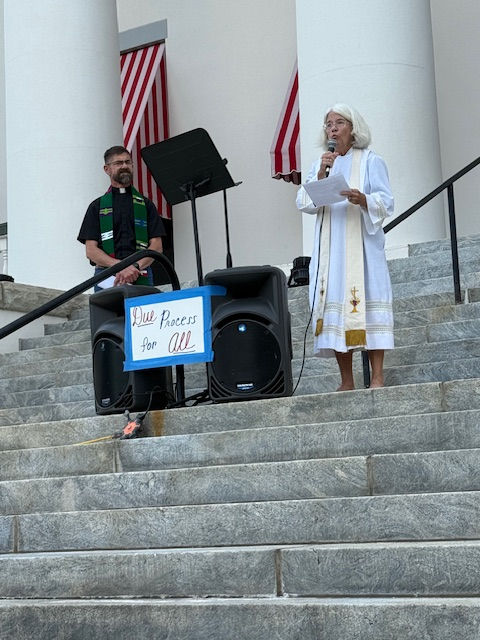
Standing on the steps of the historic capitol, it was difficult to hear about the heartache of this daughter whose father, along with hundreds of people detained in the facility, have gone missing.
One of the original organizers of the prayer vigil in the vast subtropical wetland system known as the Everglades was Florida Miccosukee Indian, Betty Osceola, who continues to supply the speaker system and to produce the weekly live stream for the vigils.
The first vigil near the facility occurred at 5p.m. with about 70 participants, including Betty. The goal, as Betty sensed it, was to simply restore empathy for others detained in the middle of what tribal members consider sacred ground.
Betty’s ancient ancestors arrived in the Florida peninsula 15,000 years ago. The detention facility in the Everglades is being built on land that is considered by the indigenous people to be sacred, ancestral, and vital for prayer, healing, and traditional uses.
Betty lives in a “chickee,” a traditional open-air dwelling built by the Seminole and Miccosukee tribes to withstand the harsh Everglades environment, about three miles from the detention center. She is known as an environmental activist, educator, and air boat captain. Betty talks about the environment being a living being in the same way that we as humans are living beings, and her heart is to care for the environment. Indeed, environmental concern is what has stymied the development of the make-shift detention center, but not completely.
According to Florida Courier, Florida’s statewide Black voice since 2006, Betty believes “People coming back to their humanity is what’s going to stop this.” She tells about a period of prayer and discernment when she asked, “What do you need me to do?” When she heard that voice in the wind telling her that human beings to be human again, that became her commitment to creator … to help people to be human beings again, to get back to their humanity.”
So, Betty Osceola asks that you leave your protest signs if you are coming to support closing the detention center in the Big Cypress Preserve where there are still 15 traditional villages and where an estimated 100 to 200 people like Betty live. "What I want you to bring is your love and your humanity and your spirituality," Betty said. " If you really believe in spirit and what life is about, then we need you to come in love and pray for this environment and pray for humanity."
This Monday is Indigenous People’s Day, celebrated annually on the second Monday of October. According to the Farmer’s Almanac, the day has an interesting history. The Director of the Rochester Museum of Art and Science from 1924 to 1945, and member of the Seneca Nation, convinced the Boy Scouts of America to observe a day for “First Americans,” from 1912-1915.
Dr. Arthur Caswell Parker’s efforts were joined by those of Rev. Red Fox James, presumed member of the Blackfeet Nation, who campaigned for a national holiday to honor indigenous people. He traveled by horseback more than 4,000 miles to seek endorsements from 24 state governors and presented them to President Woodrow Wilson at the White House on December 14, 1915.
A third early effort was made in 1915 when the president of the American Indian Association declared “American Indian Day” on the second Saturday of May each year. New York was one of the first states to officially proclaim this observance on May 13, 1916.
More recently, in 1977, as the efforts of indigenous people for an awareness day continued, they proposed to the United Nations the “International Day of Solidarity with the Indigenous Peoples of the Americas,” to be observed on October 12. In 1990, South Dakota became the first state to replace Columbus Day (the second Monday in October) with Native Americans’ Day as an official state holiday. And in 2021, President Biden became the first U.S. president to recognize Indigenous Peoples' Day officially.
While there is no set way to celebrate the day, Van Heuvelen, a member of the Cheyenne River Sioux Tribe from South Dakota, suggests a day of reflection on the history of our nation, the role first people have played in it, and what important lessons indigenous people have to teach us about the care of the earth and its creatures and plants, traditional gardening, and the care of each other.
As I think of Betty Osceola and her faithfulness, along with others, as a steward of the land and of humanity, I want to stand with her.
I closed my words spoken at the recent prayer vigil in Tallahassee with a beautiful song written by Melanie DeMore that vows, “I will be your standing stone, I will stand with you.”
It is my prayer that we all will be standing stones for each other.
Standing Stones
Rev. Candace McKibben
October 9, 2025


Comments